
Welcome to WordPress. This is your first post. Edit or delete it, then start writing!
Blog
-
WAICTANet Hosts Successful 2nd Edition of Liberia’s National Safer Internet Day Quiz Competition — St. Theresa Convent Crowned Champions
The West Africa ICT Action Network (WAICTANet–Liberia), through the Liberia Safer Internet Day (SID) Committee, proudly hosted the 2nd Edition of the National Inter-High School Online Safety Quiz Competition, marking the grand climax of Safer Internet Day 2026 celebrations in Liberia. Held at iCampus Monrovia on 25th February , 2026 under the global theme “Together for a Better Internet,” the event brought together four leading high schools in a rigorous three-round competition focused on cybersecurity, digital citizenship, cybercrime awareness, artificial intelligence trends, and responsible internet use. After an intense semi-final round, St. Theresa Convent High School advanced with a commanding 215 points against St. Mary Catholic High School, earning a place in the championship round against defending champions B.W. Harris Episcopal High School. In a thrilling final match, St. Theresa Convent secured 205 points, emerging as the new champions of the Liberia SID 2026 Inter-High School Online Safety Quiz Competition.

Since formally leading Liberia’s Safer Internet Day observance in 2018, WAICTANet has consistently positioned the country within the global movement for safer and more responsible internet use. Over the years, the initiative has reached hundreds of students through:
- School-based digital literacy workshops
- Cybersecurity awareness campaigns
- Youth dialogues on cyberbullying and misinformation
- Teacher engagement and digital safety integration programs
The introduction of the National Quiz Competition in 2025, now in its second edition, represents a strategic expansion of this work — embedding cybersecurity and digital ethics into secondary education through an interactive and competitive format.
In his remarks at the event, Peterking Quaye, Regional Executive Director of WAICTANet, emphasized the broader significance of the competition, “This platform is more than a quiz. It is a transformational space where young people sharpen their understanding of digital risks, strengthen critical thinking, and become ambassadors of safer internet practices in their schools and communities.” He further added ,“Since 2018, we have seen real change. Students are more aware of cyber threats, more confident in identifying online scams, and more responsible in their digital behavior. The emergence of St. Theresa Convent as champions — a leading girls’ institution — sends a powerful message about the growing leadership of young women in ICT.”
The crowning of a female-led institution as champions carries significant meaning, especially as the global community prepares to observe Girls in ICT Day. It reflects the increasing confidence, competence, and participation of young women in cybersecurity and digital leadership spaces. For WAICTANet, this milestone reinforces a core commitment: ensuring that girls and young women are not just participants in the digital ecosystem but leaders shaping its future, “This victory is symbolic,” Quaye noted. “It demonstrates that girls in Liberia are not only capable but are excelling in cybersecurity and digital knowledge. As we approach Girls in ICT Day, this achievement inspires us to deepen our efforts in empowering more young women in technology.” With two successful editions of the National Quiz Competition now completed, WAICTANet reaffirms its commitment to expanding the initiative nationally and advocating for replication across the Mano River Union region.
As Liberia continues to strengthen digital transformation efforts, initiatives like the Safer Internet Day Quiz Competition ensure that young people are equipped not only with access to technology but with the knowledge and responsibility to use it safely. The 2026 edition stands as another bold step in Liberia’s journey toward a safer, more inclusive, and digitally resilient future.
-
OFFICIAL STATEMENT BY THE WEST AFRICA ICT ACTION NETWORK (WAICTANet)
On the Release of the African Innovation Outlook IV (AIO-2024): Accelerating Africa’s Industrialisation through Innovation
The West Africa ICT Action Network (WAICTANet) warmly welcomes the release of the African Innovation Outlook IV (AIO-2024), a flagship continental report produced by the African Union Development Agency (AUDA-NEPAD) in collaboration with the African Union Commission (AUC). The report provides a timely, evidence-based assessment of Africa’s science, technology and innovation (STI) landscape and its critical role in accelerating industrialisation and sustainable development across the continent.
WAICTANet commends AUDA-NEPAD and the ASTII Programme for strengthening Africa’s innovation measurement systems and aligning STI indicators with Agenda 2063, the Second Ten-Year Implementation Plan, and the Sustainable Development Goals, particularly SDGs 9 and 17. The AIO-2024 rightly positions innovation—not as an abstract aspiration—but as a practical engine for economic transformation, job creation, resilience, and regional competitiveness.
For the ECOWAS region, and especially the Mano River Union (MRU) countries—Liberia, Sierra Leone, Guinea, and Côte d’Ivoire—the findings of AIO-2024 are both sobering and instructive. While innovation hubs, digital entrepreneurship, and youth-led initiatives are emerging across West Africa, the region continues to face structural constraints, including low R&D investment, limited industrial research capacity, fragmented innovation governance, and weak linkages between universities, industry, and public policy.
The report’s evidence that Africa contributes less than 1% of global R&D expenditure, with only a handful of countries meeting the 1% of GDP target, underscores a pressing challenge for ECOWAS and MRU states—many of which remain heavily dependent on primary commodities, imported technologies, and donor-driven innovation models. Without deliberate policy shifts, the region risks deepening technological dependency and missing the industrial opportunities of the Fourth Industrial Revolution.
In light of AIO-2024, WAICTANet calls for coordinated, region-specific policy reforms to unlock West Africa’s innovation and industrial potential:
- Scale Up Domestic R&D Investment
ECOWAS and MRU governments should adopt clear, time-bound national commitments to progressively increase R&D spending toward at least 1% of GDP, with dedicated budget lines for applied research, digital innovation, and industrial problem-solving relevant to local economies. - Strengthen Regional Innovation Systems
Building on ECOWAS frameworks, MRU states should pursue joint research programmes, shared innovation infrastructure, and cross-border centres of excellence in priority sectors such as agri-tech, renewable energy, digital public infrastructure, and climate-resilient manufacturing. - Link Innovation to Industrial Policy and AfCFTA
Innovation policy must be explicitly tied to industrialisation strategies, value-addition, and regional value chains under the African Continental Free Trade Area (AfCFTA), ensuring that digitalisation and emerging technologies translate into productive, inclusive industries. - Invest in Human Capital and Youth-Led Innovation
The region’s youthful population is its greatest asset. Targeted investments in STEM education, digital and industrial skills, research careers, and women-led innovation are essential to convert demographic growth into an innovation dividend. - Mobilise the Private Sector and SMEs
Governments should deploy tax incentives, innovation grants, procurement policies, and regulatory reforms that encourage private sector R&D, support SMEs to adopt new technologies, and accelerate research commercialisation. - Improve STI Data and Evidence-Based Governance
Strengthening national and regional STI observatories—aligned with ASTII standards—is critical for evidence-based policymaking, accountability, and monitoring progress across ECOWAS and MRU countries.
As a regional civil society and policy network, WAICTANet reaffirms its commitment to supporting governments, regional institutions, academia, industry, and youth innovators across ECOWAS and the MRU to translate the insights of AIO-2024 into practical action. Through research, multi-stakeholder dialogue, capacity-building, and policy advocacy, we will continue to champion innovation-driven, inclusive, and sustainable industrialisation in West Africa.
The African Innovation Outlook IV is not merely a diagnostic—it is a call to action. For ECOWAS and MRU states, the choice is clear: invest decisively in innovation today, or risk exclusion from the industries and economies of tomorrow. WAICTANet stands ready to work with all partners to ensure that West Africa’s innovation potential delivers tangible development outcomes for its people.
- Scale Up Domestic R&D Investment
-
International Day for the Elimination of Violence Against Women – 25 November 2025-Digital Violence is Real Violence: Protecting Women and Girls in Our Online Spaces
The West Africa ICT Action Network (WAICTANet) joins the global community in marking the International Day for the Elimination of Violence Against Women by sounding a clear alarm: online gender-based violence (OGBV) has become one of the fastest-growing threats to women’s safety, dignity, and participation in public life – including here in the Mano River Union (MRU) region and across West Africa.
Today Day 1 -, violence against women extends far beyond the street or home — it happens on smartphones, social media, messaging platforms, video-sharing sites and AI-driven spaces, where women and girls are stalked, humiliated, blackmailed and silenced in digital spaces meant to empower them. Globally, 38% of women online have faced digital violence, and 85% have witnessed it, from threats and harassment to non-consensual image sharing. UN Women reports that 90–95% of deepfake content targets women and girls, making AI a new weapon of abuse. Studies show 16–58% of girls and women worldwide have experienced technology-facilitated harm. Those in public roles suffer most: 73% of women journalists have endured online attacks — including doxxing, sexualized threats and smear campaigns — forcing many out of public debate due to the toll on their safety, dignity and mental health.
On this International Day, Peterking Quaye, Regional Executive Director of WAICTANet and digital rights advocate for the MRU region, states, “We cannot ask women and girls in Africa to ‘embrace the digital future’ while leaving them unprotected in the very spaces we are pushing them into. When we know that roughly four in ten women with internet access have already faced online violence, and that most deepfake content targets women’s bodies, we are no longer dealing with isolated incidents – we are facing a systemic digital harm that must be treated with the same urgency as any other form of gender-based violence.” He further adds, In the Mano River Union region, we talk about digital transformation, AI innovation, smart cities and e-governance. None of this will be legitimate if women and girls must pay for ‘innovation’ with their safety. Ending online gender-based violence is not a side-issue – it is a pre-condition for genuine digital progress in West Africa.”
Across Africa, the alarm is clear: the online environment is increasingly being weaponized against women and girls, demanding urgent protections, stronger accountability, and platforms that take African users and languages seriously. While the AU has begun responding—through the 2025 negotiation of the AU Convention on Ending Violence Against Women and Girls (AUCEVAWG) and the 2024 continental study on digital violence by the African Commission—national laws in West Africa still lag far behind women’s lived realities online. Few countries explicitly address technology-facilitated violence; data-protection systems remain weak; law-enforcement and judicial actors lack training to investigate or prosecute digital abuse; and platforms often fail to provide accessible, survivor-centred reporting and redress. In the MRU region—Liberia, Sierra Leone, Guinea and Côte d’Ivoire—where connectivity is rapidly expanding, inaction now risks embedding digital inequality and digital violence into the foundation of the next generation.
On this day, WAICTANet affirms a simple principle: if a space is not safe for women and girls, it is not fit to be called “digital development.” As a regional civil society network working at the intersection of ICT policy, digital rights, AI governance and youth empowerment, WAICTANet views online gender-based violence as a multidimensional threat: a human rights violation that infringes on privacy, dignity, freedom of expression, access to information and participation in public affairs; a public health and psychosocial crisis with documented impacts on mental health, self-harm and wider social exclusion; a democracy and governance issue, given that silencing women journalists, human rights defenders and young activists weakens society’s ability to hold power to account; and a development and digital-economy risk, as women entrepreneurs and professionals face heightened exposure to scams, extortion and reputational attacks that undermine trust in e-commerce, digital payments and online work.
-
Two Ganta Schools Join Liberia’s Largest Youth Digital Safety Movement as WAICTANet Expands Cyber Ambassador Network Across Nimba County
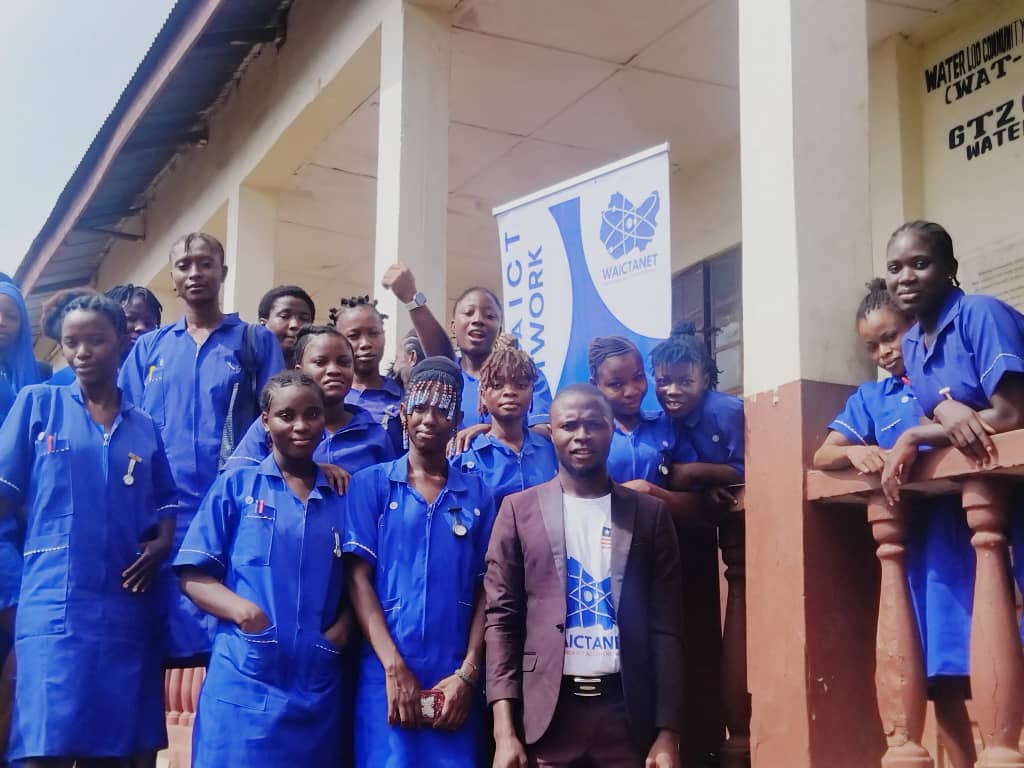
Gompa City, Nimba County — November 2025:-The West Africa ICT Action Network (WAICTANet) has taken a major step toward transforming digital education in Liberia with the addition of Christian Foundation High School and YAMCA School System Liberia to the Youth Cyber Ambassador Network – Liberia (YCAN-Liberia). The announcement followed a high-impact training held in Gompa City where over 150 senior students received hands-on instruction in AI, cyber hygiene, online safety, and digital innovation.
This expansion makes Nimba County one of the fastest-growing hubs for youth digital empowerment in the country. With its large student population and several major townships—including Sanniquellie, Bahn, Tappita, Saclepea, Yekepa, Karnplay, and Zualay,—Nimba is now set to become a strategic base for the national rollout of Liberia’s youth cyber-education movement. WAICTANet confirmed that additional schools from Sanniquellie and Tappita have already expressed interest in joining YCAN-Liberia, marking what could become the largest coordinated youth digital-safety and innovation competition Liberia has seen in recent years.
WAICTANet’s Regional Director, Peterking Quaye, described the expansion as a milestone not only for Nimba but for Liberia’s national digital future, “Today’s inclusion of these two schools signals a new chapter for Nimba County. These students now join a national movement fighting for safer, smarter, and more inclusive digital communities. When young people in Ganta, Sanniquellie, Bahn, and Tappita gain cyber awareness, Liberia becomes stronger,” Quaye said. “The Youth Cyber Ambassador Network is not just a project—it is a national force. With Nimba joining Montserrado, we are building one of Liberia’s biggest youth-led digital education platforms in recent history.” Quaye emphasized that with rising cybercrime, mobile-money fraud, identity theft, and misinformation, Liberia must prepare its young population with real digital protective skills—not theory.
The Youth Cyber Ambassador Network – Liberia (YCAN-Liberia) now includes schools and youth groups from Monrovia and Ganta, with expansion underway to major Nimba districts such as Sanniquellie, Bahn, Tappita, Saclepea, Yekepa, Karnplay, and Zualay. The network trains students as peer cyber-safety educators, builds school digital clubs, supports youth participation in AI and digital literacy competitions, and strengthens a nationwide movement of young online-safety advocates. With a target of reaching 5,000 students by 2026, YCAN-Liberia is on track to become one of the largest youth cyber-literacy initiatives in the Mano River Union, shaping how students learn, lead, and stay safe in the digital age.
Teachers from both participating Ganta schools praised WAICTANet for extending high-quality digital and cybersecurity training beyond Monrovia, noting that such opportunities are rare for schools in rural and peri-urban areas of Nimba County, including districts like Sanniquellie, Bahn, Tappita, Saclepea, Yekepa, and Karnplay, where access to structured digital education remains limited. Students expressed strong enthusiasm for the program, highlighting their excitement about learning practical cybersecurity skills, gaining a clearer understanding of how AI tools operate, joining a growing nationwide digital-safety movement, and becoming certified Youth Cyber Ambassadors capable of supporting and educating their peers and communities. Many students described the experience as their first exposure to formal cyber hygiene training, underscoring the transformative impact of WAICTANet’s outreach across Nimba. Both schools will participate in the 2026 Safer Internet Day – Nimba Edition, and be part of which WAICTANet expects to be the largest student-centered digital education event ever hosted in the county, with projected participation from multiple districts.
YCAN-Liberia’s Youth Program Lead, Etta A. Morlu, noted, “Nimba County is rising as a digital talent hotspot. These students are curious, confident, and ready to lead. With more schools joining YCAN-Liberia, we’re building a powerful youth network that will shape Liberia’s digital future.” WAICTANet says expanding youth cybersecurity training into large counties like Nimba is essential for strengthening Liberia’s digital economy and reducing cyber risks that threaten students, families, and institutions. With more schools joining the movement, Liberia is taking a decisive step toward building a generation of digitally literate, cyber-aware, and future-ready young leaders across all 15 counties.

-
Official Statement by WAICTANet on the Launch of ECOWAS SIGMAT in Liberia
The West Africa ICT Action Network (WAICTANet) joins regional stakeholders in applauding the official launch of the ECOWAS Interconnected System for the Management of Goods in Transit (SIGMAT) across Liberia, Guinea, and Côte d’Ivoire — a transformative milestone for regional trade digitization and economic integration.
The launch, marks ECOWAS’ commitment to modernizing West Africa’s transit and customs ecosystem through the seamless, real-time exchange of cargo information between customs authorities. By linking national customs systems, SIGMAT strengthens transparency, reduces delays, improves revenue assurance, and enhances security across borders. The introduction of SIGMAT in Liberia comes at a pivotal moment in the country’s digital transformation agenda, marking the first time Liberia’s customs operations will be fully integrated into a regional digital transit system that accelerates clearance processes, reduces transit times, lowers operational costs for traders and transporters, strengthens anti-fraud and anti-smuggling controls, enhances business competitiveness, and positions Liberia more effectively within AfCFTA trade flows. This development directly supports national priorities around modernizing trade facilitation, automating public services, and deepening economic cooperation across the Mano River Union and the wider ECOWAS region.
Speaking on the importance of this development, Peterking Quaye, Regional Director of WAICTANet, stated, “SIGMAT is not just a customs system — it is a gateway to a more integrated, transparent, and technology-driven West Africa. For Liberia, it accelerates our shift toward digital trade, reduces bottlenecks at border points, and positions our economy to participate competitively in regional and global markets. This is a win for business, for innovation, and for inclusive economic growth.” He further emphasised the system’s relevance for national development, “A modern transit-management system strengthens investor confidence, enhances revenue mobilization, and opens doors for youth and women entrepreneurs engaged in logistics, e-commerce, and digital finance. WAICTANet sees SIGMAT as a foundation that Liberia can build upon to expand its digital public infrastructure and drive sustainable growth.”
The launch of SIGMAT delivers a major boost to regional integration by enhancing cross-border trade among Liberia, Guinea, and Côte d’Ivoire, while aligning national systems more closely with ECOWAS and AfCFTA protocols. By reducing the risks of cargo diversion, transit fraud, and administrative bottlenecks, the system significantly improves predictability and efficiency for transport and logistics companies. It also lays the groundwork for future interoperability with digital identity systems, smart customs solutions, and broader e-trade platforms. Collectively, these advancements strengthen Liberia’s position within the Mano River Union (MRU), fostering smoother trade corridors, deeper economic cooperation, and a more connected sub-regional economy.
WAICTANet urges national and regional stakeholders — including the Liberia Revenue Authority (LRA), the Ministry of Commerce, transport unions, private-sector logistics actors, and civil society — to collaborate closely to ensure the successful deployment of SIGMAT. This includes promoting effective system rollout and monitoring, strengthening continuous capacity-building for customs officers, border-security personnel, and traders, fostering strong public-private partnerships, and integrating SIGMAT-generated data into broader digital-economy and governance reforms. Such coordinated efforts are essential to maximize the system’s impact and sustain long-term benefits for Liberia’s trade ecosystem. ECOWAS’ deployment of SIGMAT is a bold step toward a more efficient, digitally connected West Africa. As an organization committed to digital inclusion, governance, and innovation, WAICTANet stands ready to support complementary initiatives that enhance Liberia’s participation in secure, modern, and technology-enabled trade systems.
-
WAICTANet Joins National Stakeholders to Shape Liberia’s First National Data Policy
The West Africa ICT Action Network (WAICTANet) actively participated in the national Stakeholder Consultation on the Development of Liberia’s National Data Policy, held from 13-14 of November at the Mamba Point Hotel, Monrovia. The event, convened by the Ministry of Posts & Telecommunications (MoPT) in collaboration with the African Union (AU), GIZ, and the Collaboration on International ICT Policy in East and Southern Africa (CIPESA), represents a major step toward establishing a unified, rights-respecting data governance framework for Liberia. The initiative forms part of a broader African Union effort to domesticate the African Union Data Policy Framework (AUDPF), enabling member states to strengthen data governance, digital rights, and responsible data-driven innovation.
Peterking Quaye, Regional Director of WAICTANet, emphasized the importance of ensuring that Liberia’s forthcoming National Data Policy aligns with both emerging global norms and existing national legislation such as the Liberia Cybercrime Act of 2021. “Liberia stands at a defining moment in its digital evolution,” Mr. Quaye stated. “A strong, people-centred National Data Policy will transform data into a trusted public resource—strengthening privacy, transparency, and inclusion while supporting innovation and national development.”
He further stressed the need to link the National Data Policy to continental legal instruments, including the AU Convention on Cybersecurity and Personal Data Protection (Malabo Convention), to ensure interoperability, human-rights safeguards, and readiness for cross-border digital cooperation. “Data is not just information — it is power and public infrastructure. Liberia’s responsibility is to ensure that this power is used equitably, ethically, and in ways that empower citizens and strengthen institutions.” The critical importance of data integrity, was also center of the discussion -that data manipulation fuels both misinformation and disinformation—posing risks to national security, public trust, and democratic processes.
WAICTANet reaffirmed its commitment to supporting government and partners through evidence-based advocacy, technical input, and regional coordination. The National Data Policy development process will continue into early 2026 with further consultations, reviews, and validation sessions.
-
New WAICTANet–Cenerva UK Strategic Partnership to Build Digital Regulatory Excellence in the Mano River Region
The West Africa ICT Action Network (WAICTANet), a regional multi-stakeholder platform advancing inclusive digital transformation across West Africa, and Cenerva, a specialist digital regulatory-policy consultancy headquartered in the UK with global training credentials, have formally entered into a strategic partnership to strengthen regulatory capacity and digital-skills development across the Mano River Union (MRU) region, comprising Liberia, Sierra Leone, Guinea, and Côte d’Ivoire.
This partnership responds to the urgent need for dynamic regulatory institutions, market-aware policy frameworks, and skilled professionals capable of steering the region’s rapidly evolving digital economy. By combining Cenerva’s globally recognized expertise in regulatory training and advisory services with WAICTANet’s strong local presence, convening power, and youth-focused approach, the initiative aims to deliver practical, results-driven impact rooted in the realities of the MRU region.
The programme’s first-year roadmap is built around four integrated components designed to accelerate regulatory capacity and digital-governance readiness. The MRU Regulatory Masterclasses (TRMC-MRU)—adapted from Cenerva’s world-renowned Telecoms Regulatory Masterclass—will combine virtual learning, in-country workshops, and certification pathways covering telecom and digital-economy regulation, spectrum and numbering strategy, competition and consumer protection, emerging technology governance (including cloud services, platforms, and fintech), and data-governance and inclusion readiness. With a proven record of training more than 6,500 professionals across over 140 countries, Cenerva’s expertise will ensure world-class content contextualized to local regulatory realities.
Complementing the masterclasses, Hands-On Labs and Policy Sprints will create practical spaces for regulators and operators to model spectrum and numbering strategies using regional data. These will be coupled with co-designed policy-sprint sessions involving regulators, youth networks, and civil-society actors to generate actionable policy guidelines on issues such as fair competition, digital inclusion, and innovation-friendly regulation. A Youth Scholarships and Mentorship stream, led by WAICTANet, will prioritize participation from women and rural communities, offering mentorship, alumni networking, and structured career pathways into regulatory, policy, and digital-industry roles.
In addition, the Regional Advisory and Institutional Strengthening component will provide targeted technical assistance to MRU governments and regulators on cross-border challenges including roaming, spectrum harmonization, digital-market oversight, and data-governance readiness—ensuring long-term institutional capacity and policy coherence across borders.
A formal Memorandum of Understanding (MoU) between the two institutions establishes a Joint Steering Committee (JSC) co-chaired by WAICTANet and Cenerva, with national focal points appointed in each MRU country. Both partners commit to transparent resource allocation, inclusive participant selection, and a sustainability plan that incorporates a train-the-trainer model, cost-sharing mechanisms, and continued regional collaboration. Cenerva will contribute its established curricula and global faculty, while WAICTANet will leverage its policy expertise, youth-engagement platforms, and local operational capacity to ensure effective regional delivery.
The programme targets the training of at least 120 regulators and policymakers in its first year, laying a strong foundation for enhanced regional digital-governance capacity. It will prioritize diversity and inclusion, ensuring that at least 40% of participants are women and 30% are youth under 30, to foster gender balance and empower the next generation of digital-policy leaders. The initiative will also produce four draft policy guidelines for MRU regulators—focusing on spectrum management, numbering frameworks, and digital-market governance—to serve as actionable outputs influencing both national and regional policies. To guarantee sustainability and continuous learning, the partnership will establish a regional alumni network and conduct a tracer survey 12 months after training completion to evaluate participants’ career progression, institutional uptake of skills, and overall professional impact.
As the MRU region experiences unprecedented digital transformation—marked by surging mobile connectivity, the expansion of digital platforms, and new cross-border markets—governments face emerging challenges related to data flows, inclusion, cybersecurity, and fintech innovation. Strengthening regulatory institutions and building a skilled professional base are critical to ensuring sustainable investment, fair competition, user protection, and inclusive innovation. By linking local insight with global best practice, the partnership between WAICTANet and Cenerva represents a pivotal step toward accelerating the region’s journey from knowledge to policy to measurable impact.
-
WAICTANet Launches “Ghana Digital Policy Watch” to Engage Civil Society on over 13 New Digital Bills
The West Africa ICT Action Network (WAICTANet) has announced the launch of the Ghana Digital Policy Watch & Civil Society Consultation Platform to coordinate non-state input on more than 13 draft digital and technology-related bills currently being processed by Ghana’s Ministry of Communication, Digital Technology and Innovations.
The platform will serve as a hub for analysis, stakeholder feedback, and regional best-practice sharing on key draft instruments including the Emerging Technologies Bill (2025), Data Harmonisation Bill (2025), Digital Economy & Innovation Development Fund Bill (2025), Cybersecurity (Amendment) Bill (2025), Data Protection Bill (2025), and the Misinformation, Disinformation & Hate Speech Bill (2025), among others.
“What Ghana is doing is not a minor regulatory update — it is a complete redesign of its digital governance architecture. Civil society, startups, media, and academia must not be spectators,” said Peterking Quaye, Regional Director, WAICTANet. “Our platform is to ensure that innovation, human rights, security, and regional interoperability are all reflected in the final laws.”
The Ghana Digital Policy Watch aims to create an inclusive, evidence-based platform that brings together civil society, the private sector, academia, and innovation hubs to shape the country’s ongoing digital law reforms. It will aggregate public and expert views on each of the 13 draft digital bills, ensuring that citizen voices and sector-specific insights are reflected in the final legislative outcomes. The platform will also map regional alignment with ECOWAS, the African Union, and Smart Africa frameworks, drawing lessons from the experiences of Nigeria and Kenya to promote coherence and best practice across West Africa.
Through a series of bill-by-bill online briefings, open calls for written submissions, and policy notes identifying risks, gaps, and regional comparisons, WAICTANet will coordinate structured engagement with Parliament, ministries, and regulators. This approach will ensure that government receives consolidated, data-driven recommendations that balance innovation, investment, and human-rights protection.
WAICTANet’s monitoring focus will include the independence of the new Data Protection Commission, the scope and safeguards of the Misinformation, Disinformation and Hate Speech Bill, the governance of the .gh domain and national digital infrastructure, and the incentives and protections for startups, tech hubs, and creative digital SMEs. The initiative will also critically examine cybersecurity powers to guarantee judicial oversight and safeguard digital freedoms. “Ghana can become the model for rights-respecting digital regulation in West Africa — but only if the process is inclusive,” said Peterking Quaye, Regional Director of WAICTANet. “We invite Ghanaian CSOs, tech communities, legal researchers, and innovation hubs to work with us in shaping a digital future that is both innovative and rights-centered.”
-
Peterking Quaye to Champion Digital Inclusion Dialogue at 7th Annual Youth Education and Leadership Conference 2025
The West Africa Young Parliamentarians Network (WAYPA) has officially invited Mr. Peterking Quaye, Regional Director for Programs and Projects at the West Africa ICT Action Network (WAICTANet) and Convener of the Liberia Internet Governance Forum (LIGF), to serve as a facilitator at the upcoming 7th Annual Youth Education and Leadership Conference (AYEAL Conference 2025).The high-level conference, slated for November 20–22, 2025, at Jackie’s Guest House in Ganta, Nimba County, will convene young leaders, parliamentarians, policymakers, and youth advocates from across the West African sub-region under the theme, “Empowering Youth for a Sustainable Future.”
Mr. Quaye will facilitate a breakout session on “Digital Inclusion and Internet Governance: Progress and Challenges within West Africa” on November 21, 2025, at 2:00 PM. The session will explore the region’s progress in bridging the digital divide, advancing internet governance frameworks, and empowering youth to lead in the evolving digital landscape. WAICTANet, a leading regional platform advancing inclusive digital transformation, has been instrumental in promoting policy dialogue and youth participation in digital governance across the Mano River Union (MRU) region—comprising Liberia, Sierra Leone, Guinea, and Côte d’Ivoire. Mr. Quaye’s engagement reflects the organization’s broader mission to strengthen youth capacity and policy innovation through collaboration and evidence-based advocacy.
Speaking on the invitation, Peterking Quaye remarked, “I am deeply honored to join the 7th Annual Youth Education and Leadership Conference as a facilitator. Digital inclusion is not merely about access—it’s about empowering young people to create, innovate, and influence the digital future of our continent. West Africa’s youth must be equipped to engage in internet governance processes, shape policy outcomes, and safeguard their rights in the digital era.” He added that WAICTANet remains committed to building cross-border networks, supporting data governance education, and advancing human rights–based digital transformation initiatives.
This year’s event will also mark the official launch of the West Africa Young Parliamentarians Network (WAYPA) — a platform bringing together young Members of Parliament from across West Africa. The network seeks to amplify youth participation in decision-making, strengthen democratic governance, and encourage regional collaboration on laws and policies affecting young people. WAYPA members from The Gambia, Sierra Leone, Senegal, Mali, Guinea-Bissau, Ghana, and Nigeria will attend the official signing of a Memorandum of Understanding (MoU) establishing the network. The ceremony will be witnessed by government officials, civil society representatives, youth and women’s groups, traditional leaders, and development partners from across the sub-region. The Annual Youth Education and Leadership Conference serves as one of West Africa’s premier platforms for youth policy dialogue, capacity building, and leadership exchange. The 2025 edition aims to inspire young leaders to become proactive contributors to sustainable development, digital transformation, and democratic accountability in their countries.
The West Africa ICT Action Network (WAICTANet) is a regional, multi-stakeholder organization advancing digital inclusion, internet governance, cybersecurity awareness, and youth empowerment across West Africa. Through initiatives such as the Liberia Internet Governance Forum, the MRU Youth IGF, and the Academy for Digital Empowerment, WAICTANet continues to promote safe, inclusive, and sustainable use of digital technologies in the sub-region.